Creative landscapes since 2018
(828) 699-0157
Guide
What Goes Under a Patio (and Why It Matters)
Most patio problems, like sinking, shifting and puddles, start below the surface. Here’s every layer we build under a patio or walkway, and why.
By Blue Ridge Landscaping and Hardscaping · Updated November 2026
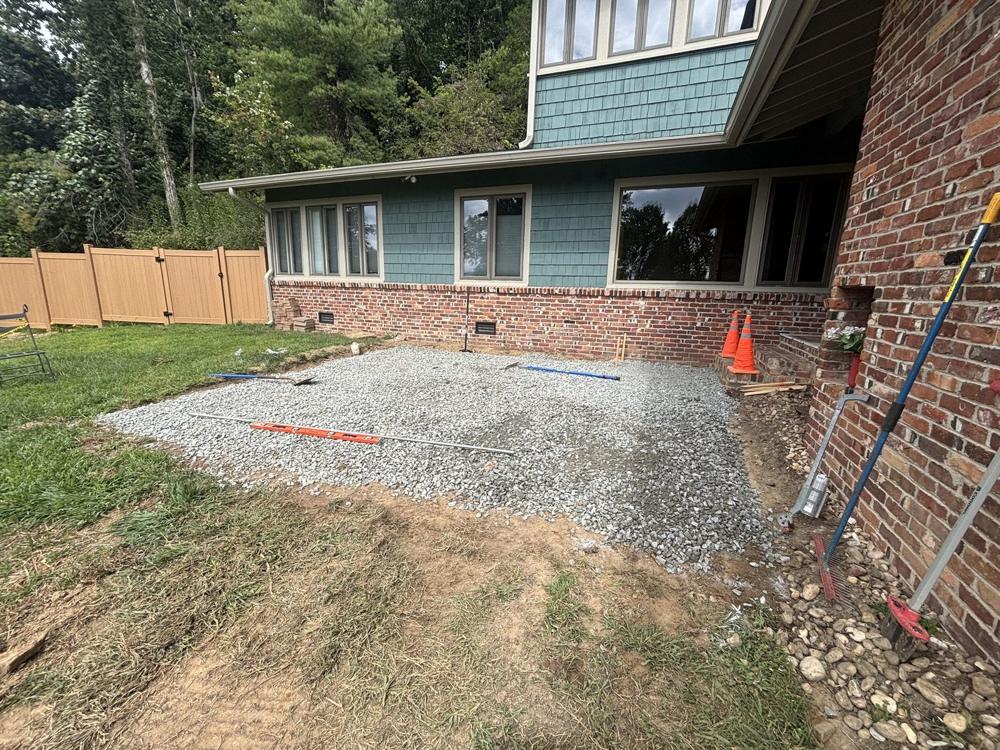
When a patio sinks, tilts or holds puddles, the problem is almost never the pavers or stone. It’s what’s underneath. A patio is only as good as its base, and in our area’s clay soils and heavy rain, the base has one main job: get water out of the way.
Here’s what we build under every patio and walkway, from the bottom up.
4. Geotextile fabric
The first thing that goes down on the prepared soil is a layer of geotextile fabric. It keeps soil from washing up into the stone above it. Without it, mud slowly works its way into the gravel, clogs it and stops it from draining. With it, the stone stays clean and keeps draining for years.
3. Four inches of 3/4″ washed stone
Next comes about 4 inches of 3/4″ washed stone. This is the subbase, and it does two things. It spreads the weight of the patio and everything on it, and because the stone is washed, there are open spaces between the pieces for water to drain through instead of sitting under your patio.
2. A 1-inch leveling layer
On top of the subbase goes a 1-inch leveling layer that the pavers or stone are set into. Traditionally this is sand. We usually use 1/4″ minus stone instead. It’s a newer method, and we recommend it over sand because it drains better and holds its shape for more stability.
1. Pavers or stone
Finally, the pavers, natural stone or other surface go down. Joints are filled with polymeric sand, which hardens to help lock everything in place, or another joint style you prefer.
What about driveways?
Driveways use the same idea with thicker pavers or stone to handle the weight of vehicles.
Why this matters for you
A drainage-first base is why we can back our patios and walkways with a 10-year warranty against settling and shifting. Learn more about choosing the surface in our guide to pavers vs. concrete vs. natural stone.
Ready to talk about your project?
Veteran owned and operated · BBB accredited · Licensed, insured & bonded · Free estimates